Innovirtuz Technologies Pvt Ltd

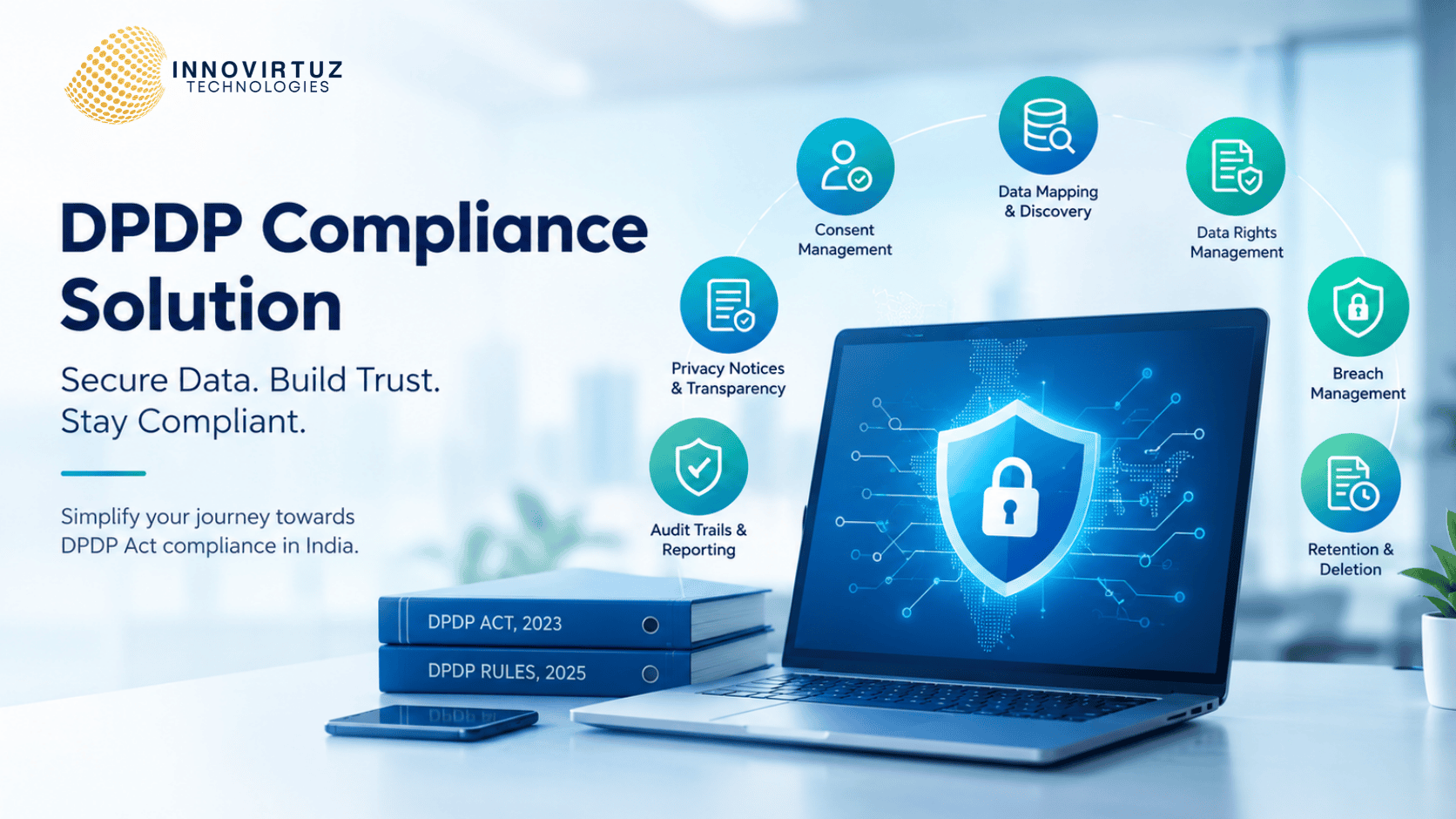
DPDP Compliance Solution: A Practical Guide for Businesses in India
Businesses today collect and process personal data at almost every digital touchpoint—from websites and mobile applications to customer onboarding, employee systems, CRM platforms, cloud applications, and connected devices. As the volume of digital personal data grows, organisations need stronger processes to understand how data is collected, used, stored, shared, and deleted.
In India, the Digital Personal Data Protection Act, 2023 (DPDP Act) establishes a legal framework for processing digital personal data while recognising individuals’ rights and organisations’ need to process data for lawful purposes. The Government subsequently notified the Digital Personal Data Protection Rules, 2025, providing the implementation framework for the Act.
This is where a DPDP compliance solution can help organisations turn privacy requirements into practical, repeatable processes.
What Is a DPDP Compliance Solution?
A DPDP compliance solution is a combination of technology, processes, controls, and governance practices designed to help an organisation operationalise its obligations under India’s data protection framework.
It can help organisations manage activities such as:
- Personal data discovery and mapping
- Consent collection and management
- Privacy notices
- Consent withdrawal
- Data Principal rights requests
- Data retention and deletion
- Data breach workflows
- Audit trails and compliance evidence
- Vendor and Data Processor governance
- Privacy risk assessment
- Compliance monitoring
Importantly, the DPDP framework does not simply require an organisation to purchase a particular software product. The organisation remains responsible for establishing appropriate processes and controls. Technology can help automate and manage these activities at scale.
Why Is DPDP Compliance Important for Businesses?
For many organisations, personal data is distributed across multiple systems and departments. Marketing may collect customer information through websites, sales teams may use CRM platforms, HR may manage employee records, and IT teams may maintain databases and cloud infrastructure.
Without proper governance, organisations can struggle to answer basic questions:
- What personal data do we collect?
- Why do we collect it?
- Where is it stored?
- Who can access it?
- Which third parties process it?
- How is consent recorded?
- How can an individual withdraw consent?
- When should personal data be deleted?
- What happens when a data breach occurs?
A structured DPDP compliance programme helps bring these activities under a defined governance framework.
The DPDP Rules, 2025 also place emphasis on clear and understandable notices, including information about the personal data being processed and the purpose of processing. They also provide mechanisms relating to consent withdrawal, exercising rights, and complaints.
Key Components of a DPDP Compliance Solution
1. Personal Data Discovery and Mapping
The first step is understanding what personal data exists within the organisation.
A compliance solution can help identify data across databases, applications, cloud environments, websites, mobile applications, HR systems, CRM platforms, and other business systems.
Data mapping can provide visibility into:
- What personal data is collected
- The purpose of processing
- Where data is stored
- How data moves between systems
- Which teams access the data
- Which third-party Data Processors handle it
This visibility creates a foundation for effective privacy governance.
2. Consent Management
Consent is an important part of the DPDP framework where consent is the applicable legal basis for processing.
A technology-enabled consent management system can help organisations capture, record, track, update, and manage consent across different digital touchpoints.
It can also help maintain records that demonstrate what an individual consented to and when.
The DPDP Rules, 2025 emphasise clear, standalone, understandable notices and provide for mechanisms through which Data Principals can withdraw consent and exercise their rights.
3. Data Principal Rights Management
The DPDP framework provides rights to individuals, referred to as Data Principals.
Organisations therefore need processes to receive, verify, track, and respond to applicable requests.
A DPDP compliance solution can provide a central workflow for managing these requests instead of relying on scattered emails, spreadsheets, or manual follow-ups.
This can improve accountability and make it easier for privacy teams to track request status and supporting evidence.
4. Data Retention and Deletion
Collecting personal data is only one part of data governance. Organisations also need to understand how long data should be retained and when it should be removed, subject to applicable legal and business requirements.
A compliance solution can connect retention policies with operational systems and create workflows for data deletion or review.
Automating these processes can reduce the risk of retaining personal information longer than necessary.
5. Data Breach Management
Data security is a critical component of privacy compliance.
Organisations need appropriate technical and organisational measures to protect personal data and processes for responding to incidents.
A DPDP compliance solution can support:
- Incident reporting
- Internal escalation
- Breach response workflows
- Evidence collection
- Notification processes
- Incident tracking
- Post-incident review
A centralised workflow can help organisations respond consistently rather than building a response process from scratch during an incident.
6. Audit Trails and Compliance Evidence
One of the challenges of privacy management is demonstrating what an organisation actually did.
A good compliance solution should maintain appropriate records of activities such as consent events, policy changes, rights requests, data processing activities, and compliance actions.
These records can help privacy, legal, security, and management teams understand the organisation’s compliance position and identify gaps.
How to Implement DPDP Compliance in India
A practical implementation approach can be divided into several stages.
Step 1: Identify Personal Data
Create an inventory of the personal data your organisation collects and processes.
Step 2: Map Data Flows
Document where data comes from, where it goes, how it is processed, and which third parties have access to it.
Step 3: Identify Compliance Gaps
Compare existing practices, systems, policies, contracts, and processes against applicable DPDP requirements.
Step 4: Establish Privacy Controls
Implement appropriate consent, notice, access, retention, deletion, security, and rights-management processes.
Step 5: Automate Where Practical
Use compliance technology to reduce manual work and create consistent workflows across systems.
Step 6: Monitor and Improve
DPDP compliance should be treated as an ongoing operational programme rather than a one-time documentation exercise.
What Should You Look for in a DPDP Compliance Solution?
Before selecting a solution, organisations should evaluate whether it can support their actual data environment.
Important capabilities may include:
Data discovery: Can the solution identify personal data across relevant systems?
Consent management: Can it capture, record, manage, and support withdrawal of consent?
Rights management: Can teams efficiently manage Data Principal requests?
Data lifecycle management: Can retention and deletion workflows be tracked?
Security and breach workflows: Can incidents be escalated and documented?
Auditability: Can the organisation generate useful compliance evidence?
Integration: Can the solution connect with existing CRM, ERP, HR, cloud, IoT, and other business systems?
Scalability: Can it support growing volumes of users, data, applications, and processing activities?
For IoT-driven organisations in particular, data privacy can become more complex because connected devices may continuously generate or transmit information. A compliance approach should therefore consider not only websites and applications but also connected devices, gateways, cloud platforms, APIs, and third-party services where personal data may be involved.
DPDP Compliance Solution vs. Manual Compliance
Manual processes may work for small volumes, but they can become difficult to maintain as organisations scale.
| Manual Approach | DPDP Compliance Solution |
|---|---|
|
Spreadsheet-based tracking |
Centralised compliance workflows |
|
Manual consent records |
Structured consent management |
|
Email-based requests |
Trackable rights-request workflows |
|
Scattered documentation |
Centralised compliance evidence |
|
Manual data discovery |
Automated or assisted discovery |
|
Reactive breach handling |
Defined incident workflows |
|
Periodic reviews |
Continuous monitoring and visibility |
The objective is not to replace legal or privacy expertise. Instead, technology can give teams the visibility and operational controls required to manage privacy activities more efficiently.
DPDP Compliance in 2026: Why Businesses Should Prepare
The Government notified the DPDP Rules, 2025 on 14 November 2025, along with an enforcement timeline and the establishment of the Data Protection Board of India. The official MeitY materials identify phased commencement rather than treating every provision as effective on a single date.
This makes preparation important for organisations that process digital personal data.
Businesses can use this period to identify data flows, review privacy notices, establish governance, assess technology gaps, train employees, review third-party relationships, and implement appropriate privacy controls.
Starting early also gives technology and business teams time to integrate compliance into existing workflows rather than treating it as a last-minute project.
Frequently Asked Questions About DPDP Compliance
Q1. What is a DPDP compliance solution?
Ans. A DPDP compliance solution helps organisations operationalise privacy and data protection requirements under India’s Digital Personal Data Protection framework. Depending on the organisation, it may include data discovery, consent management, rights management, retention, deletion, breach workflows, audit trails, and governance capabilities.
Q2. Is DPDP compliance software mandatory?
Ans. The DPDP framework establishes obligations and outcomes for organisations; it does not simply mandate that every organisation purchase a particular software product. Technology can, however, help organisations manage complex compliance processes more efficiently at scale.
Q3. Who needs to consider DPDP compliance?
Ans. Organisations that fall within the scope of the DPDP Act and process digital personal data need to assess their applicable obligations. The specific requirements can vary depending on the organisation, its processing activities, and its role under the framework.
Q4. Can DPDP compliance be automated?
Ans. Several operational activities can be automated or supported through technology, including consent workflows, data discovery, rights-request tracking, retention workflows, notifications, and audit records. Human oversight remains important for legal, governance, security, and risk decisions.
Conclusion: Build a Smarter DPDP Compliance Strategy
DPDP compliance is more than updating a privacy policy. It requires organisations to understand their data, establish appropriate governance, protect personal information, manage consent and rights, maintain evidence, and respond effectively to incidents.
A DPDP compliance solution can bring these activities together through structured workflows, automation, visibility, and continuous monitoring. For businesses managing large volumes of customer, employee, partner, or connected-device data, this technology-led approach can make privacy management more organised and scalable.
Ready to strengthen your organisation’s DPDP readiness?
Explore a technology-driven DPDP compliance solution that helps simplify data discovery, consent management, privacy workflows, security controls, and compliance monitoring. Connect with our experts today to assess your current data protection environment and build a practical roadmap for DPDP compliance.
Disclaimer: This article is intended for general informational purposes and does not constitute legal advice. Organisations should assess their specific obligations under the DPDP Act, 2023 and DPDP Rules, 2025 with qualified legal and privacy professionals.